
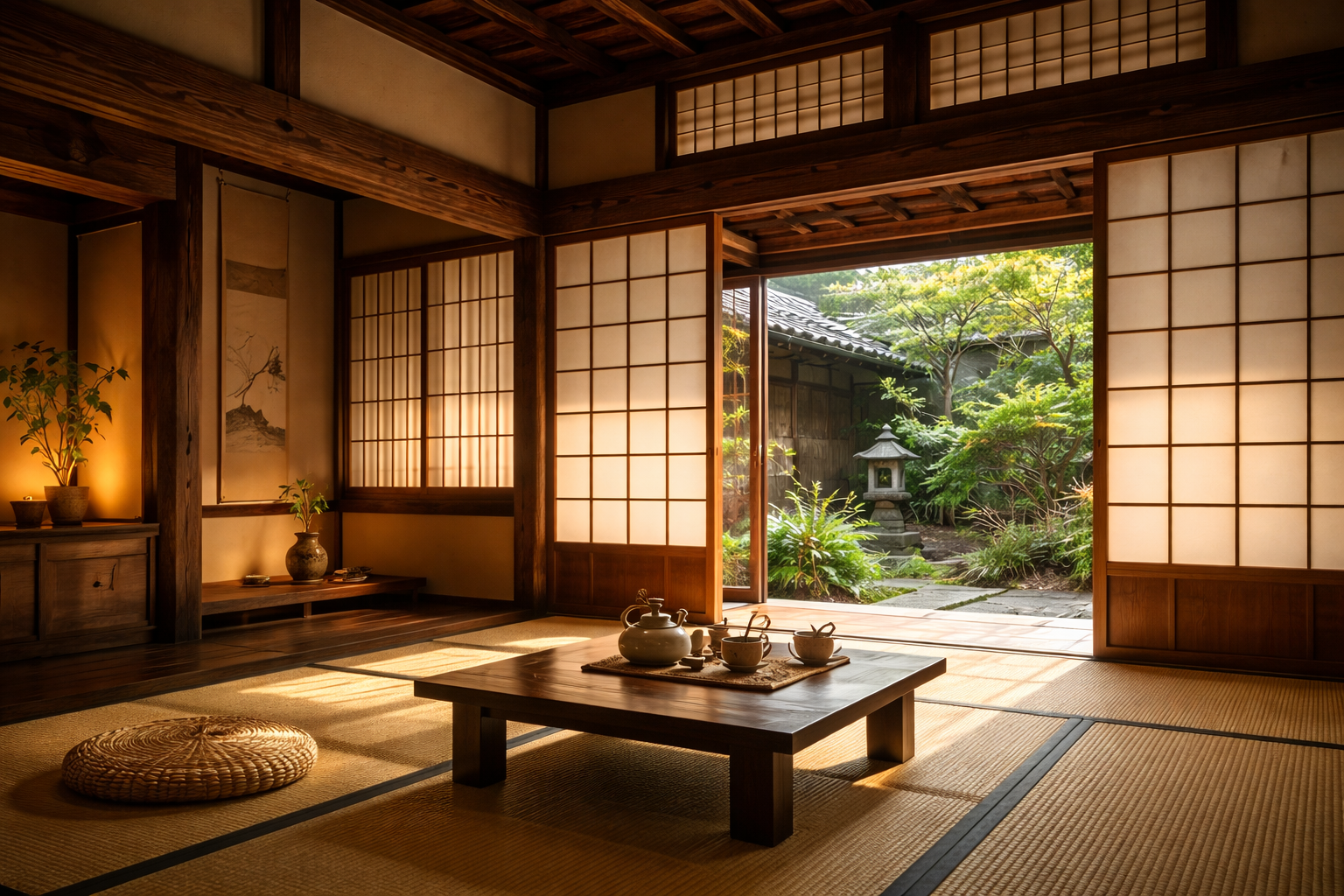
What Does Staying in a Traditional Japanese House Actually Feel Like?
"I want to sleep on tatami." "I want to wake up to light coming through shoji screens." "I want to feel what it's like to live inside an old Japanese house." These are desires that more and more travellers bring to Osaka — and they're entirely achievable.
Staying in a traditional Japanese house — whether it's called a machiya (town house), kominka (old folk house), or simply a renovated pre-war building — is a fundamentally different experience from a hotel. It's not just accommodation: it's an immersion into a way of living that has largely disappeared from modern Japan.
What you experience in a traditional Japanese house stay
Sleeping on tatami
The faint scent of rush grass, the subtle give underfoot — even with a bed placed on top, a tatami floor transforms the quality of a room in ways that are hard to describe until you've felt it.
Light through shoji screens
Morning light filtered through washi paper shoji has a quality entirely unlike curtains or glass — diffused, gentle, and deeply calming. Waking up to it is one of the quiet pleasures of a machiya stay.
Dark timber beams overhead
Beams blackened over a century of use carry a weight of history that no new-build can replicate. Looking up at them is a constant, quiet reminder of how long this house has stood.
The whole house, just for you
A whole-house rental means your group has the entire building — no other guests, no shared corridors. It feels less like a hotel and more like borrowing a home, which is exactly the point.
Osaka vs Kyoto: Where to Stay in a Traditional Japanese House
Kyoto is the most famous destination for machiya stays — and for good reason. But Osaka has its own compelling case, and for many travellers, it's actually the better choice.
| Factor | Osaka · Yodogawa (Oideya) | Kyoto · Machiya Stay |
|---|---|---|
| Access to city centre | 5 min to Umeda by train | 15–30 min to Kyoto Station |
| Nightly rate (whole house) | From ¥15,000 | From ¥30,000+ |
| Nearby sights | Dotonbori, Osaka Castle, Namba | Kinkaku-ji, Fushimi Inari, etc. |
| Access to Kyoto | 30–40 min by train | In Kyoto |
| Neighbourhood feel | ◎ Quiet residential, authentic local life | △ Tourist-heavy areas |
| Traditional architecture | ◎ Pre-war beams, tatami, shoji | ◎ Edo-Meiji period townhouses |
| Max capacity | 8 guests (Oideya) | Varies by property |
If your itinerary includes both Osaka and Kyoto — or Osaka, Kyoto, and Nara — using Oideya as your base dramatically reduces accommodation costs while keeping all three cities within easy reach.
Oideya Guest House: A Pre-War Machiya in Osaka
Oideya Guest House, located in Yodogawa-ku near Kanzakigawa Station, is a pre-war machiya (approximately 100 years old) that has been carefully renovated as a private whole-house rental. It sleeps up to 8 guests.
Ground floor: where old Japan meets modern design
The living room retains the original dark timber beams of the pre-war structure, but pairs them with Bauhaus prints, a cobalt-blue sofa, a gallery wall of framed artwork, and a kotatsu heated table. It's an interior that shouldn't work — and yet somehow does, creating a space that's both genuinely old and genuinely contemporary.
Upper floor: the tatami rooms
Upstairs, shoji screens, tatami flooring, and a soft rice-paper lamp create the quiet, traditional atmosphere that many travellers come to Japan seeking. Double beds have been placed on the tatami — you get the texture and feeling of a traditional room with the sleeping comfort of a proper bed.
A century of history.
Five minutes from Umeda.
Oideya is a pre-war machiya in Yodogawa-ku, Osaka — the entire building is yours as a private rental. Dark timber beams, tatami bedrooms, and a modern living room, all within 5 minutes of Umeda by train. Up to 8 guests.
How to Make the Most of a Traditional Japanese House Stay
① Wake up early and watch the light through the shoji
The single most memorable thing many guests describe is the quality of morning light in the tatami room. Set an alarm, make tea, and simply sit with it for a while. There's nothing quite like it.
② Cook with ingredients from the local supermarket
Oideya has a full kitchen. The Hankyu Oasis supermarket is a 5-minute walk. Picking up ingredients and cooking in a century-old Japanese kitchen is an experience that no restaurant can replicate — and it's one of the most effective ways to feel at home in a foreign city.
③ Spend an evening under the kotatsu
The kotatsu — a low table with an electric heater underneath, covered by a futon blanket — is a Japanese winter institution that surprises almost every international guest who encounters one. Sit around it with your group on a cold evening, and you'll understand immediately why it endures.
④ Walk the neighbourhood without a plan
The streets around Oideya are not in any guidebook. There's a seafood izakaya two minutes away that's been feeding locals for decades. There are small temples, old shop facades, and the ordinary rhythms of a Japanese residential neighbourhood. Walking through it without a destination is one of the most genuinely immersive things you can do in Osaka.
💡 For international guests
Oideya supports communication in English, Chinese, and Korean. Self check-in is available at any time, making late-night arrivals straightforward. Guests from over 30 countries have stayed, and written reviews are available in multiple languages on Booking.com and Airbnb.
Getting There & How to Book
Oideya is bookable on the following platforms:
- Booking.com — Score 8.5 · Traveller Review Awards 2026 Winner
- Airbnb — Listed as a whole-house rental
- Agoda — Also available via Booking.com
Nearest station: Hankyu Kobe Line, Kanzakigawa Station (short walk). Osaka-Umeda Station is approximately 5 minutes by train. Namba and Dotonbori are reachable within 30 minutes with one transfer.
Frequently Asked Questions
The Bottom Line
Staying in a traditional Japanese house in Osaka is one of those travel experiences that stays with you long after you've left. Not because of a particular sight or dish, but because of a feeling — the texture of tatami underfoot, the quality of morning light through shoji, the weight of history in a dark timber beam above your head.
Oideya Guest House offers that experience in a location that makes practical sense: 5 minutes from Umeda, close to Kyoto, with room for up to 8 guests in a fully private building. If you've been wondering what it's really like to live inside a piece of Japanese history — even for just a few nights — this is where to find out.