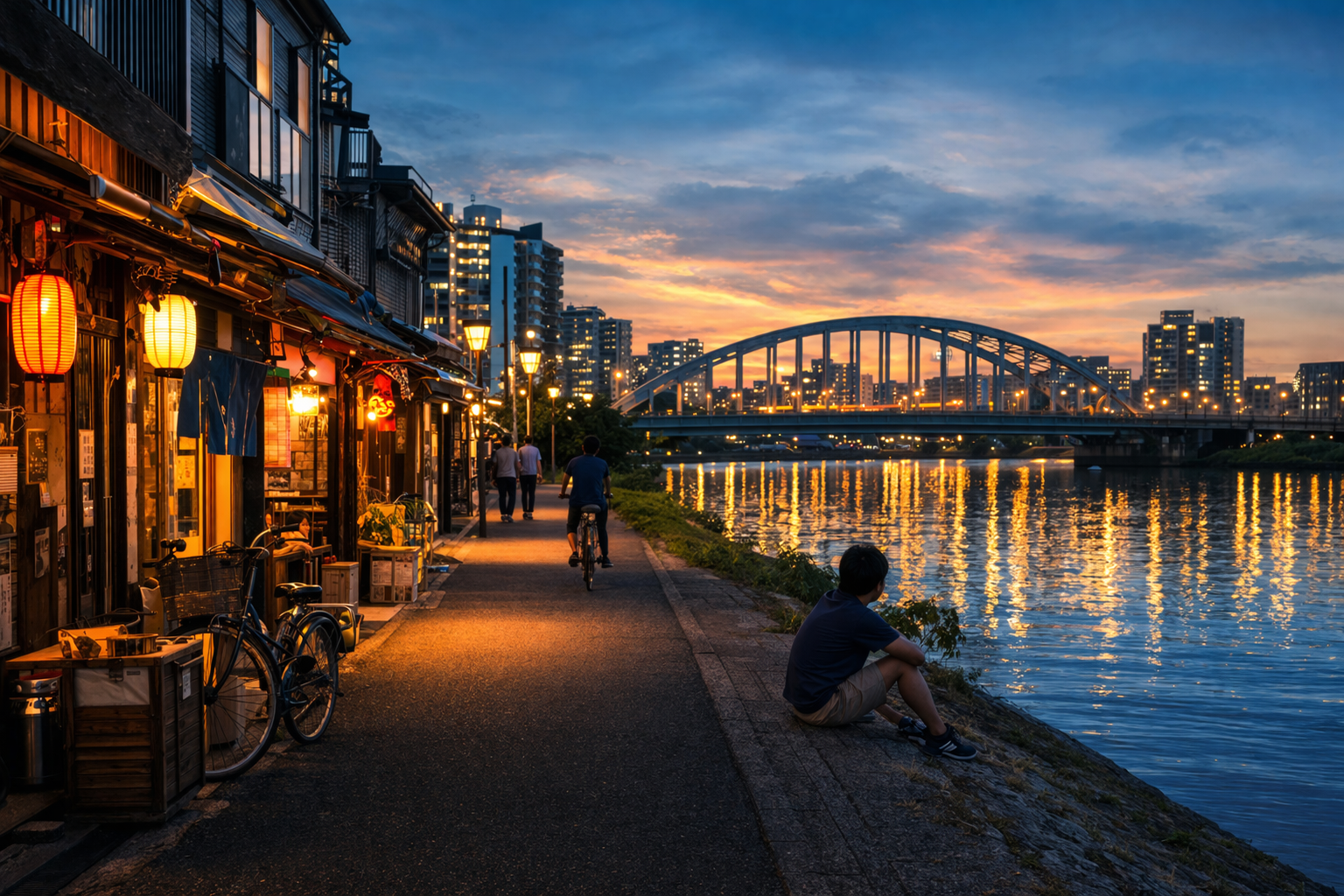
The Glico sign, Dotonbori, Osaka Castle, Shinsekai — you've seen the big hits. But just a few stops by train from Umeda, there's a different Osaka entirely. One that travel guides rarely mention, where a 70-year-old sweet shop still draws queues outside the station every morning, where a uniquely Osaka dish called negiyaki was born, and where a covered shopping arcade full of independent shops has been feeding the neighbourhood since long before anyone thought to photograph it.
This is Juso and Kanzakigawa — two to three stops on the Hankyu line, and the everyday Osaka that most visitors never quite reach.
Juso (十三) — The Birthplace of Negiyaki
Two stops from Osaka-Umeda, about five minutes. Step off at Juso Station and you're immediately inside a covered arcade that extends in multiple directions — east, west, north, south. Travel writing tends to describe Juso as a drinking district, and at night that's accurate enough. But the daytime version of Juso belongs to the people who live here, and they've been eating extremely well for a very long time.
Kiyasu Sohonpo — mitarashi dango since 1948
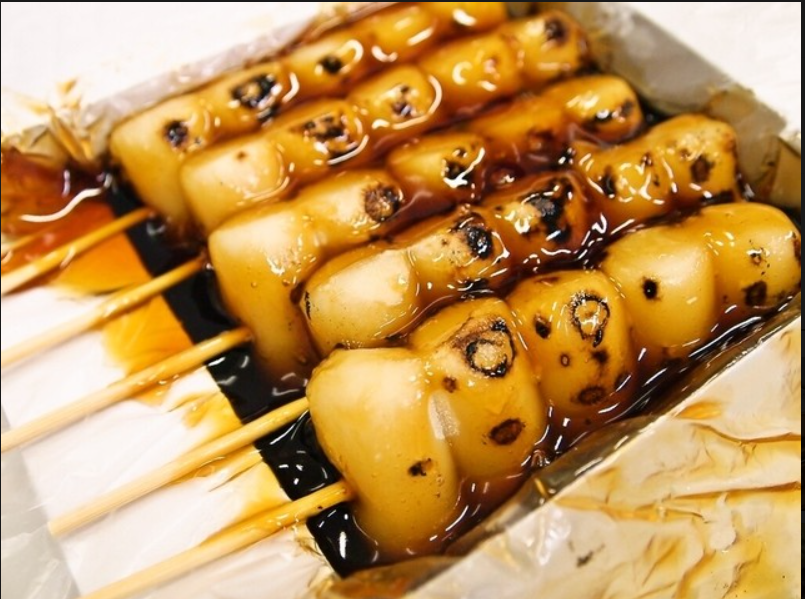
Walk west from Juso Station and within a minute you'll smell it before you see it: the sharp, sweet char of freshly grilled mitarashi dango. Kiyasu Sohonpo (喜八洲総本舗) has been on this spot since 1948, and the queue outside hasn't really stopped since. Their mitarashi dango is made in a distinctive cylindrical shape — not round like most versions — specifically so the sauce clings more completely. It's been recognised as an "Osaka Product of Excellence," and the super-speed wrapping technique of the staff has appeared on national television multiple times.
"Make it before the signal changes." The speed of Kiyasu's staff was forged by decades of Juso commuters with trains to catch.
The mitarashi dango is the headline, but the sake manju (steamed buns made with sake) and kintsubu (gold-leaf sweet bean cakes) are equally worth your time. Everything is made the same day it's sold — no stale stock, no shortcuts. The Juso main store is about one minute on foot from the station's west exit.
Negiyaki — Juso's own dish
Juso is widely known as the birthplace of negiyaki: a close relative of okonomiyaki, packed with Kujo green onions and cooked flat on an iron griddle. Where okonomiyaki is filled with cabbage and various proteins, negiyaki is primarily about the negi — the green onion doing most of the work, soft and sweet from the heat. The founding restaurant is Negiyaki Yamamoto, which opened in 1965 and still draws queues outside its west-side location, about a three-minute walk from the station. It's the dish Osaka locals think of when they think of Juso, and it's very much worth seeking out.
Juso now
Juso is a neighbourhood in quiet transition. The long-established restaurants sit alongside newer ramen shops, standing bars, and cafes that have opened in recent years. The old and new coexist without much friction — it's a neighbourhood that knows what it is. According to the restaurant guide Gurunavi, Juso has "long been known as an entertainment district, but the shopping street extending from the station is lined with many popular and distinctive restaurants." Three Hankyu lines intersect here — the Kobe, Takarazuka, and Kyoto lines — making it one of the better-connected local hubs in the city.
🚃 Getting to Juso
Hankyu Kobe, Takarazuka, and Kyoto lines. Approximately 5 minutes from Osaka-Umeda (2 stops). One stop from Kanzakigawa.
Kanzakigawa & Mitsutsuya — A Showa-era arcade and a medieval river
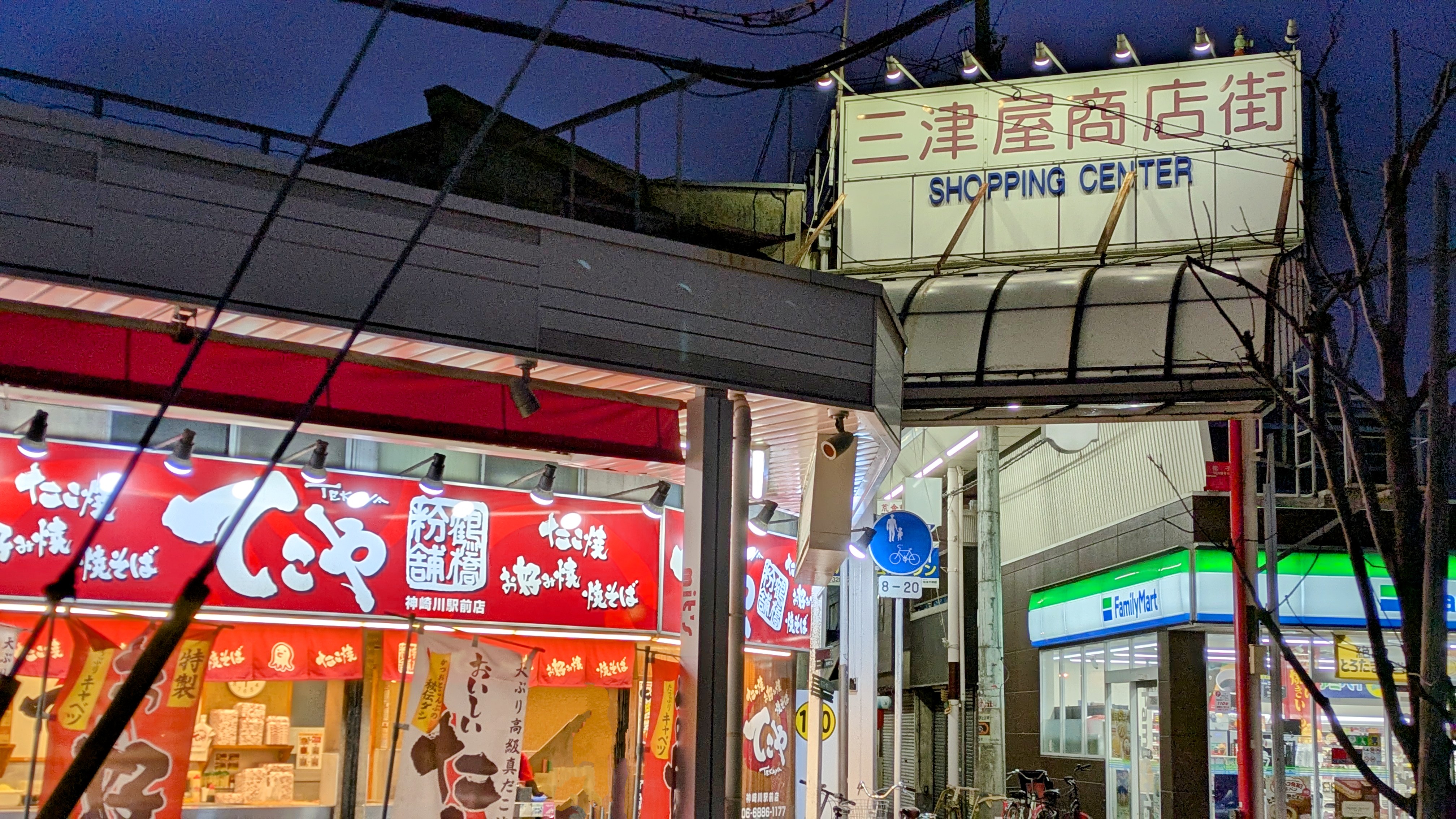
Two stops further along the Hankyu Kobe Line from Juso — three stops total from Osaka-Umeda, about eight minutes. Kanzakigawa Station is smaller and quieter, and the neighbourhood around it is almost entirely residential. Step outside the south exit and you're immediately at the entrance of Mitsutsuya Shotengai — a covered shopping arcade roughly 550 metres long, running south from the station.
The arcade where Yakacurling was invented
Mitsutsuya Shotengai has a dedicated following among people who appreciate shopping arcades that have stayed resolutely themselves. At its peak the arcade had around 150 shops; the number has declined over the decades, but food shops, izakayas, and local businesses still fill the covered street. What it has kept is character.
In 2006, inspired by the Japanese curling team's performance at the Torino Winter Olympics, the people of Mitsutsuya Shotengai invented Yakacurling — a sport played with a kettle fitted with casters and filled with cement, slid across a surface towards a target. The "Yakacurling World Championships" are held twice a year, alongside the "Mitsuya Day" event every March 28th (3/28, a wordplay on "mi-tsu-ya") and the summer "Mitsutsuya Dontaku" festival. It is precisely the kind of neighbourhood ingenuity that makes a place worth visiting.
Within walking distance of the arcade: the Michelin Guide-listed udon restaurant Byakuan, the seafood izakaya Shunkashuutou, and the family-friendly Yoruca cafe, among others — all covered in our Kanzakigawa restaurant guide.
The Kanzakigawa River — a medieval crossing point
The area takes its name from the river that flows just to the north. The name "Kanzakigawa" traces back to a river crossing called Kanzaki no Watashi that stood here on the road from Osaka towards the San'yō region. The name is said to have been established by the early Edo period (17th century), and the crossing was a significant point on a busy road for several centuries before that. The river is still a first-class waterway in the Yodo River system, still flowing through northern Osaka much as it always has. Walking along its banks, you get a quiet sense of how long people have been passing through this particular place.
Making it your base
Juso and Kanzakigawa are not destinations in the way that Dotonbori or Osaka Castle are destinations. They don't ask you to marvel at them. What they offer instead is something harder to find in a city that gets as many visitors as Osaka: the chance to spend a few hours somewhere that is simply going about its life.
The mitarashi dango queue at Kiyasu in the morning. Negiyaki on a cast-iron griddle for lunch. The covered arcade in the afternoon, with its mix of shops that have been open for thirty years alongside ones that opened last month. Dinner at a seafood izakaya where the catch came in that morning. All of it within about ten minutes of Umeda, thirty minutes of Namba.
Use the gaps in your itinerary. The afternoon after USJ. The evening before a Kyoto day trip. The hour before heading back to the airport. One extra stop on the Hankyu line is all it takes.
Juso and Kanzakigawa
are both right here.
Oideya Guest House is within walking distance of Kanzakigawa Station. Mitsutsuya Shotengai is minutes away on foot; Juso is one stop by train. You can spend your days in central Osaka — Umeda, Namba, Osaka Castle — and come back each evening to a neighbourhood that's still quietly, entirely itself.
Check Availability →