
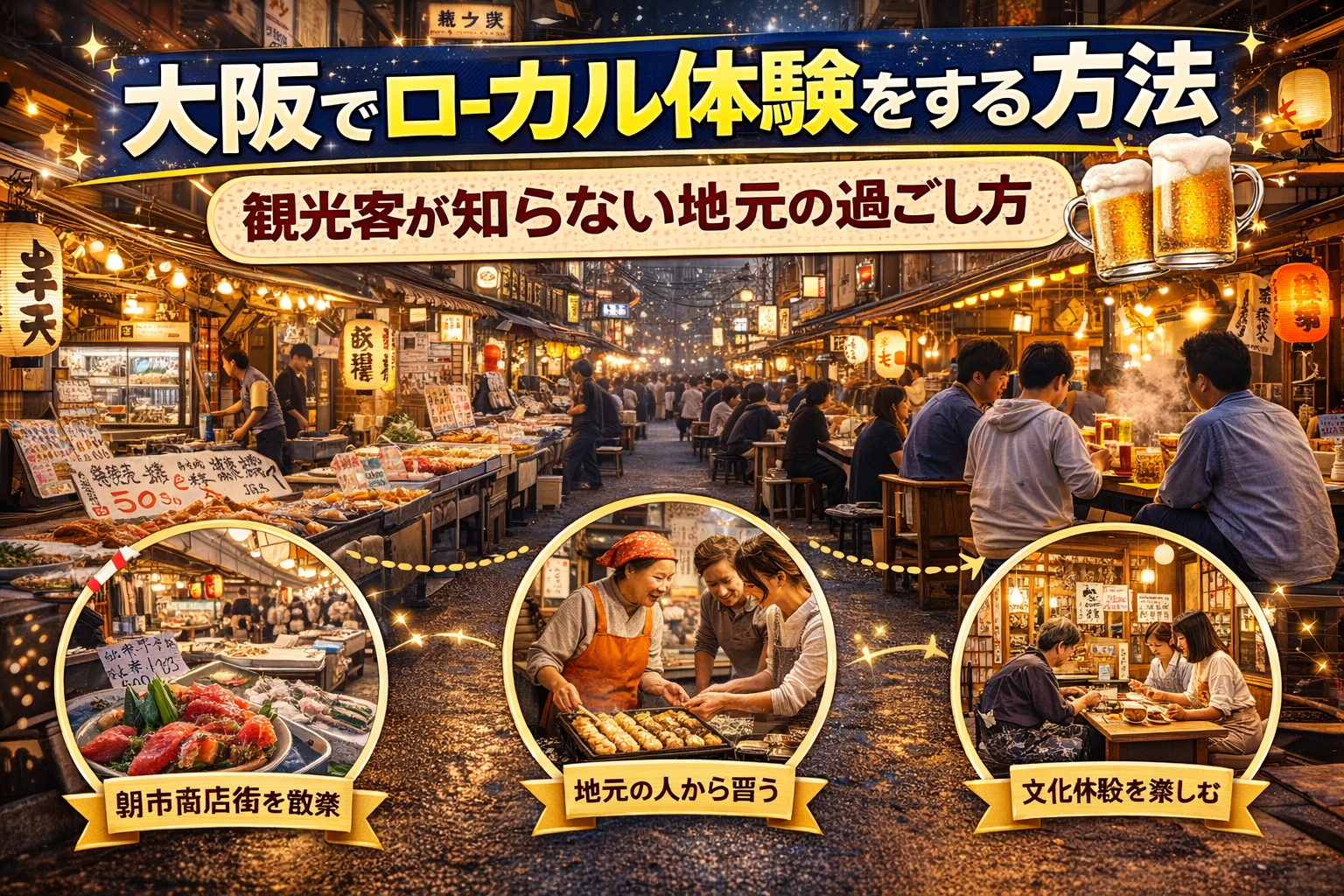
What "local experience" actually means
There's a difference between visiting a city's attractions and spending time in the places where people live. Local experience means encountering the city through infrastructure built for residents rather than visitors — the shops they use, the food they eat, the rhythms they follow.
In Osaka's case, the tourist version of the city — Dotonbori, Namba, Osaka Castle — is already well-documented. But a few stops from Umeda, in residential wards like Yodogawa, there are Michelin-listed udon restaurants that charge under ¥1,000, covered shopping arcades that haven't changed since the 1970s, and neighbourhood izakayas where the owner picks the fish himself every morning. Reaching those places is what this guide is about.
Eat where locals eat
Not the restaurants designed for visitors — the ones where the people who live here go on a Tuesday.
Stay in a residential neighbourhood
Where you sleep determines what you see when you leave and return. A hotel district and a residential street are different cities.
Walk a shotengai
Japan's covered shopping arcades contain a kind of local commercial culture that supermarkets and malls replaced everywhere else.
Cook with local ingredients
A neighbourhood supermarket and a kitchen tell you more about a city's food culture than any restaurant review.
Choose the right area
Where you stay is the most important decision for a local-focused Osaka trip. The hotel clusters around Namba and Dotonbori are convenient — but they make it hard to leave the tourist version of the city.
A better approach: stay in a residential area with good transit access to the main sights. The Yodogawa ward — specifically the Kanzakigawa and Juso areas — sits a few stops from Umeda on the Hankyu Kobe Line. You can reach Dotonbori in 25–35 minutes, Osaka Castle in 30–40 minutes. But when you come back in the evening, you're coming back to a neighbourhood that's going about its life.
The key insight: Staying in a local neighbourhood doesn't limit your access to tourist sights — it just means the city you return to each evening is the real one.
① Eat where locals eat
Osaka's food culture is famous for good reason — but "food in Osaka" as a tourist experience and food as a local daily activity are quite different things.
Byakuan udon — Michelin-listed, under ¥1,000
One minute on foot from Kanzakigawa Station: Byakuan, a Michelin Guide-listed udon restaurant that costs under ¥1,000. The chef trained as a washoku (Japanese cuisine) cook before opening this shop. The noodles use 100% domestic wheat; the broth uses iriko from Ibuki Island in Kagawa, blended with konbu and katsuobushi. The gap between this and tourist-area udon is the gap between a restaurant built for its neighbourhood and one built for foot traffic.
Sanuki Udon Byakuan (白庵)
1 min walk from Kanzakigawa Station · Michelin Guide-listed · Tabelog Top 100 Udon 2024 · Opens 11:00 · Closed Wed & 2nd/4th Tue. → Full restaurant guide
Negiyaki — born in Juso in 1965
Juso, one stop from Kanzakigawa, is where negiyaki was invented. Negiyaki Yamamoto has been making it since 1965 — Kujo green onions, beef tendon, konnyaku, cooked flat on a griddle, dressed with soy and lemon. It's completely different from okonomiyaki, not widely known outside Osaka, and not on any tourist itinerary unless you go looking for it.
Neighbourhood izakayas
The izakaya (Japanese pub) is one of the most distinctive social institutions in Japan. At its best, it's a counter, a chalkboard menu written that morning, and food made by the same people who've been making it for decades. Shunkashuutou in Kanzakigawa (2 min from Oideya) is this kind of place: the owner buys the fish at market every morning. That's a different relationship to food than a restaurant group with forty locations.
② Walk a shotengai
A shotengai (商店街) is a covered shopping arcade — a long, roofed street lined with independent shops. Most were built in the postwar period to serve local residents. Supermarkets and shopping centres have taken most of their business, but a significant number survive, and they contain something that modern retail has mostly eliminated: visible local commerce at a human scale.
Mitsutsuya Shotengai in Kanzakigawa (immediately outside Oideya's door, about 550m long) is a working example. Food shops, an izakaya, a butcher, household goods — mix of businesses that serves the people who live nearby, not people who've come to look at it. The arcade also has its own invented sport (Yakacurling, created here in 2006) and its own annual events. That kind of self-organisation is what distinguishes a neighbourhood from a postcode.
How to walk a shotengai: Don't go with a shopping list. Follow smells. Stop when something is unfamiliar. Buy something small. The best version of this experience is unhurried.
③ Stay in a machiya
The difference between staying in a hotel and staying in a traditional Japanese house is not primarily about comfort or price. It's about what the building itself contributes to the experience.
A machiya (traditional townhouse) or kominka (old folk house) built a century ago has dark timber beams blackened over decades of use, tatami floors with a faint scent of rush grass, shoji screens that turn morning light into something worth waking up for. These aren't amenities — they're the accumulated character of a building that has actually been lived in. Staying in one makes the architecture of Japan experiential rather than visual.
Oideya Guest House — a pre-war machiya in Osaka
Yodogawa-ku, Osaka · near Kanzakigawa Station · ~6–7 min to Umeda by train · Whole house, private · Up to 8 guests · Full kitchen, washer, kotatsu · Booking.com 8.5 · 2026 Traveller Review Award Winner. → Full machiya guide
④ Cook with local ingredients
Eating at a restaurant is one kind of engagement with a city's food culture. Buying ingredients at a local supermarket and cooking with them is a different kind — more active, more revealing, and in some ways more memorable.
Hankyu Oasis, a local supermarket chain, is 5 minutes on foot from Oideya. The dashi stocks, the regional vegetables, the fresh fish and tofu from local producers — these tell you things about Osaka's food culture that a restaurant menu can't. If you're staying somewhere with a full kitchen (as Oideya has), cooking one meal during your trip is worth the hour it takes.
⑤ Follow local rhythms, not tourist hours
Most visitors structure their days around opening times and tourist crowds. Local experience often requires a different schedule:
- Morning: Neighbourhood supermarkets are busy early — locals buying breakfast before work. The atmosphere is unhurried and domestic.
- Lunchtime (11:30–13:00): The lunch rush at local restaurants is a distinct experience — quick, efficient, unpretentious. Byakuan udon at 11:00 before the queue builds is a good example.
- Late afternoon: Shopping arcades are busiest when people are coming home from work. This is the right time to walk a shotengai.
- Early evening (17:00–18:00): Neighbourhood izakayas open and fill quickly with locals. Arriving at opening time means you'll almost certainly get a seat without waiting.
Oideya as a base for local experience
Oideya Guest House is where all of this converges. A machiya built in the early Showa period, within walking distance of Mitsutsuya Shotengai, one minute from a Michelin-listed udon shop, two minutes from a market-fresh seafood izakaya, five minutes from a local supermarket. Transit to the main Osaka sights takes 25–40 minutes from the front door.
The point isn't that this is better than staying in Namba — it's that it's different in kind. A different kind of trip, producing a different kind of memory.
The local Osaka experience
starts with where you stay.
Pre-war machiya · whole house · up to 8 guests · ~6–7 min to Umeda by train. Michelin udon, local izakaya, Showa arcade — all within walking distance. Booking.com 8.5 · Traveller Review Awards 2026.
Check Availability on Booking.com →