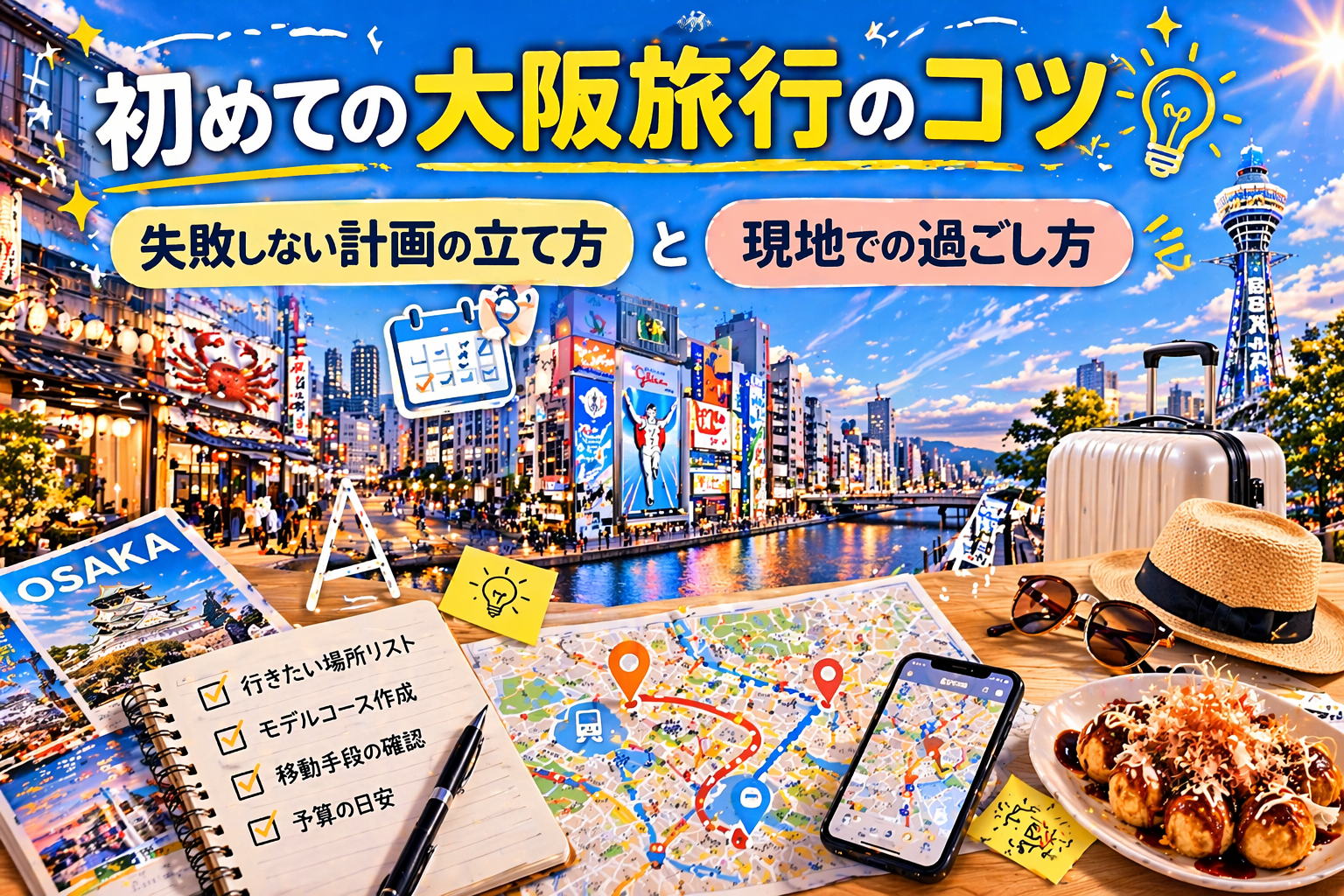
Osaka rewards first-time visitors more generously than almost any Japanese city. It's compact enough to navigate without difficulty, generous enough to make every meal feel like a discovery, and good-humoured enough that even minor mishaps tend to become good stories. What follows is a practical guide — not a list of the obvious, but the things that actually determine whether a first Osaka trip works.
① How many days: minimum 2 nights, ideally 3
The right number of days depends on what you want to do. Two nights covers the main sights; three opens up day trips to Kyoto, Kobe, or Nara.
| Duration | What you can do | Best for |
|---|---|---|
| 1 night / 2 days | Dotonbori and Namba area only | Transit stop / short business trip |
| 2 nights / 3 days | Minami + Osaka Castle or Tennoji + Shinsekai | First visit with limited time |
| 3 nights / 4 days | All of the above + Kyoto or Kobe day trip | First visit with room to breathe ← recommended |
| 4+ nights | Local areas, Nara, Himeji too | Those who want to go slow |
Osaka makes an excellent Kansai base. Kyoto is about 45 minutes from Umeda by Hankyu; Kobe is about 30 minutes; Nara is about 40 minutes from Namba by Kintetsu. Staying in Osaka and day-tripping is more efficient than moving hotels between cities.
② Where to stay: the area matters
Osaka's two main accommodation zones are Umeda (Kita, the north) and Namba / Shinsaibashi (Minami, the south). Both work well — but they feel different, and for groups or families there's a third option worth knowing.
| Area | Character | Best for |
|---|---|---|
| Umeda (Kita) | Osaka's main transport hub. JR, metro, and private lines. Dense hotel supply. | Transit priority · business travel |
| Namba / Shinsaibashi (Minami) | Tourist and restaurant centre. Dotonbori and Kuromon Market within walking distance. | Sightseeing focus |
| Yodogawa / Kanzakigawa | Residential. 6–7 min to Umeda by train. Local shotengai, udon, izakaya within walking distance. Whole-house machiya available. | Groups, families, local experience |
Oideya Guest House — a base that earns its keep
Kanzakigawa area, Yodogawa-ku · ~6–7 min to Umeda by train · Pre-war machiya, whole house, up to 8 guests · Full kitchen, washer, kotatsu · Michelin-listed udon 1 min walk · Seafood izakaya 2 min walk · Booking.com 8.5 · Traveller Review Awards 2026 Winner. → Machiya stay details
③ Getting around: two lines cover most of it
Osaka's transit network is large, but first-time visitors need fewer lines than they think.
- Osaka Metro Midosuji Line: The north–south spine. Umeda → Shinsaibashi → Namba → Tennoji in one straight run. This is the line you'll use most.
- JR Osaka Loop Line: Circles the city. Osaka Castle Park, Tennoji, and Shin-Imamiya (for Shinsekai) are all on this line.
- Hankyu Railway: From Umeda to Kyoto, Kobe, Takarazuka — and to Juso and Kanzakigawa on the Kobe Line. Also useful for day trips.
A Suica or ICOCA IC card works on almost every line in Osaka. Mobile Suica via Apple Pay or Google Pay is widely accepted and means you never need to buy individual tickets. Set it up before you arrive.
Umeda Station has different names depending on the line: "Osaka-Umeda" (Hankyu and Hanshin), "Umeda" (Osaka Metro), and "Osaka" (JR). They're all close to each other but on different concourses. This confuses almost every first-time visitor — check the line name, not just the station name.
④ Must-see sights for a first visit
These six are the ones that earn their place on a first Osaka itinerary.
🦞 Dotonbori & the Glico Sign
Osaka's most iconic image. The canal, the neon, the food stalls — best at night. Walk both banks of the Dotonbori River.
🏯 Osaka Castle & Park
Associated with Toyotomi Hideyoshi. The keep houses a history museum; the top floor gives a city-wide view. The park alone is worth half a day.
🗼 Shinsekai & Tsutenkaku
Retro-neon neighbourhood with kushikatsu restaurants on every street. About 10 minutes' walk from Tennoji.
🛍 Shinsaibashi & Amerika-mura
Shopping arcade, street art, vintage shops. Walkable north from Namba. Osaka's youth culture district.
🌆 Umeda Sky Building
Open-air observation deck at 173m. 360° city view. One of Osaka's best vantage points, less crowded than you'd expect.
🏙 Abeno Harukas (Tennoji)
One of Japan's tallest buildings at 300m. Observation floor with exceptional views. Tennoji Park and Shitenno-ji temple nearby.
Namba / Dotonbori → Shinsaibashi (walkable), then Osaka Castle → Tennoji → Shinsekai (JR Loop Line, about 15 min each). Grouping geographically cuts travel time. See the 3-day model itinerary for a worked example.
⑤ Essential Osaka food: 7 things to eat
Osaka is genuinely one of the world's great food cities. These seven things are the ones worth specifically seeking out on a first visit.
- Takoyaki: Octopus balls — the symbol of Osaka street food. Try more than one stall.
- Okonomiyaki: Savoury pancake with cabbage, protein, and toppings. Many excellent shops in the Dotonbori and Shinsaibashi area.
- Kushikatsu: Deep-fried skewers, originated in Shinsekai. The no-double-dipping sauce rule is famous and strictly enforced.
- Doteyaki: Beef tendon slow-cooked in miso. Eaten alongside kushikatsu; rich and deeply savoury.
- Udon (local): Byakuan in Kanzakigawa (Michelin-listed, 1 min from the station) represents the neighbourhood udon that tourists rarely find — and it's significantly better than tourist-area versions.
- Negiyaki: A close relative of okonomiyaki using Kujo green onions instead of cabbage, born in Juso in 1965. Unknown to most visitors and completely worth finding.
- Mitarashi dango from Kiyasu Sohonpo: Cylindrical mochi skewers, grilled to order, from a 1948 Juso institution. One of Osaka's distinctive local sweets.
Eating every meal at the tourist-facing restaurants in Dotonbori. The best food in Osaka is in residential streets and neighbourhood arcades. Getting one meal at a place that serves locals — not visitors — noticeably changes the quality of a trip's food memories.
⑥ Practical tips for the first visit
Escalators
In Osaka, stand on the right side of escalators and leave the left side clear for people walking past (the opposite of Tokyo, where you stand on the left). You'll notice this immediately once you know to look for it — blending into the local flow makes things run more smoothly.
Osaka people
Osaka has a reputation — mostly accurate — for friendliness and directness. People will talk to you. Shop owners will engage. The local dialect (Osaka-ben / Kansai-ben) sounds different from standard Japanese; "maido" (welcome), "nanbō?" (how much?), and "chau" (that's wrong / no) are common phrases. Don't worry about understanding everything — the warmth comes through regardless.
Luggage storage
Coin lockers are plentiful at Umeda, Namba, and Tennoji stations in various sizes. If you're staying at Oideya, the washer means you can pack lighter and do a load mid-trip rather than carrying a week's worth of clothes.
Eating times
Dotonbori and Namba stay busy very late. But neighbourhood izakayas open at 17:00–18:00 and fill quickly — arriving at or just after opening means no wait. If you want a seat at a popular local place, this is the most reliable approach.
First time in Osaka?
The base matters more than you think.
Pre-war machiya, whole house, up to 8 guests — ~6–7 min to Umeda by train. Michelin udon, local izakaya, and Showa-era arcade within walking distance. All of Osaka's main sights, plus Kyoto and Kobe, within range. Booking.com 8.5 · Traveller Review Awards 2026.
Check Availability on Booking.com →