
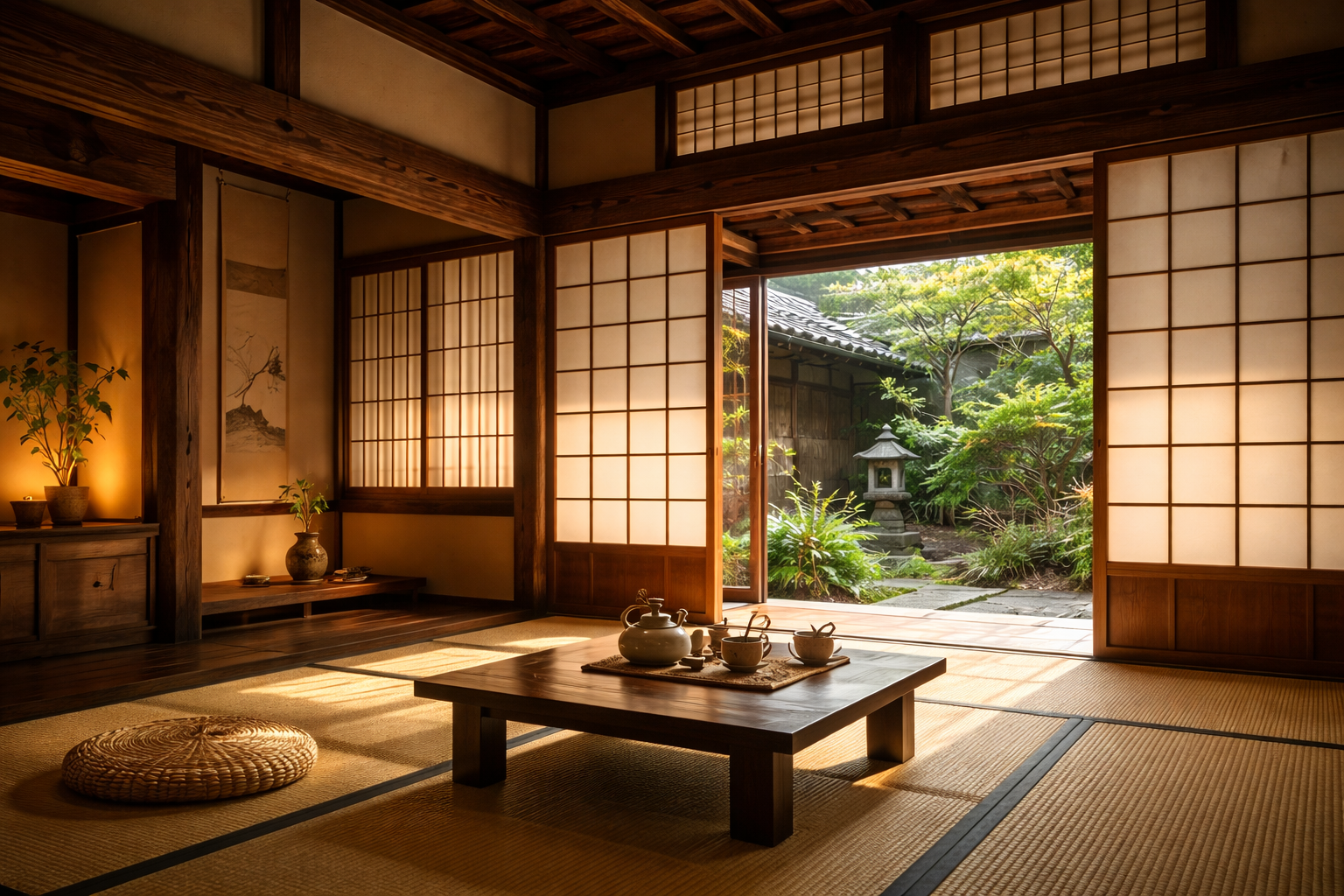
What is a traditional Japanese house?
The umbrella term covers several related building types. A kominka (古民家, "old folk house") is conventionally defined as a wooden dwelling more than 50 years old. A machiya (町家) is an urban townhouse, typically built on a long narrow plot with the shop at the front and living quarters behind. Both share the same structural logic: post-and-beam timber frames, earthen walls, tatami floors, shoji and fusuma screens, and tiled or thatched roofs.
What distinguishes them from modern buildings is that the materials age visibly and beautifully. Timber darkens and develops a lustre. Tatami fades from bright green to warm amber. Earthen walls acquire texture and colour variation over decades. The building accrues character through use — the opposite of the hotel room, which is designed to resist the evidence of time.
In recent years, many kominka and machiya have been sensitively renovated for use as guesthouses and short-term rentals: the original structure and materials preserved, modern plumbing and appliances added, and the result offered to travellers seeking something that a hotel cannot provide.
What makes a Japanese house different
Tatami (畳)
Rush-grass mats that cover the floor. Bare feet on tatami have a slight springiness and warmth that hard flooring lacks. New tatami is bright green with a faint, clean scent of rushes; it fades over time to warm amber. Sleeping on a futon laid directly on tatami is a different physical experience from a bed — closer to the floor, the body supported differently, the room smelling faintly of grass.
Shoji (障子)
Sliding panels of wooden lattice covered with washi paper. They admit light while obscuring the view — the effect is a soft, fully-diffused white glow rather than either bright sunlight or darkness. On an east-facing room in the early morning, the light through shoji changes gradually, almost imperceptibly, in a way that a curtained window cannot replicate. Many people who have stayed in a traditional Japanese house name this as their strongest memory.
Exposed timber beams (梁・柱)
In old kominka, the structural beams are left visible rather than hidden behind plasterboard. Over decades of use — cooking smoke, wood oils, the slow chemistry of the material itself — they darken to near-black, acquiring a deep lustre. Looking up at these beams in a room that is otherwise quiet and low-lit is one of the distinctive aesthetic experiences of Japanese vernacular architecture. The beams are not decoration; they are the evidence of time passing in a single place.
Engawa (縁側) — the in-between space
A narrow boarded veranda running along the perimeter of the house, between the interior and the garden. Neither fully inside nor outside. Traditionally used for sitting, drying things, watching rain, or simply existing in the transitional space between the house and the world. The engawa is one of the most culturally specific spatial inventions of Japanese domestic architecture — and one of the most immediately appealing to visitors who encounter it for the first time.
Fusuma and sliding doors (襖・引き戸)
Japanese houses are divided by sliding panels rather than fixed walls. This means spaces can be expanded or contracted — open the fusuma between two rooms and they become one large room; close them and you have two private spaces. For a group or family staying together, this flexibility is practically useful as well as architecturally interesting.
Six reasons to choose a traditional Japanese house over a hotel
The building itself is the experience
Hotel rooms are designed to be identical and interchangeable. A kominka is unrepeatable — its age, materials, and character are specific to that building and irreplaceable by any other.
You live in Japanese culture, not just observe it
Sleeping on tatami, sliding shoji open in the morning, warming under a kotatsu at night — these are things you understand differently through doing than through seeing in a museum.
A private whole house for your group
A whole-house rental means the entire building is yours — no shared corridors, no other guests. Particularly good for families or groups who want to spend time together rather than divided across hotel rooms.
A kitchen for cooking with local ingredients
Most renovated kominka include a full kitchen. Buying ingredients at a local supermarket and cooking in a hundred-year-old house is a form of engagement with a place that restaurants alone cannot provide.
A residential neighbourhood, not a tourist zone
Kominka are found in residential areas rather than hotel districts. The surrounding street — its shops, its sounds, its daily rhythms — is part of the stay.
Stronger memories
A generic hotel room is hard to remember specifically. A particular house — its smells, the quality of its light, the weight of its sliding doors — creates lasting, specific memories. The accommodation becomes part of the story of the trip.
Hotel vs. traditional Japanese house: a comparison
| Category | Hotel (typical) | Kominka / Japanese house |
|---|---|---|
| Spatial uniformity | High (chains are globally consistent) | Low — every building is unique |
| Cultural experience | Minimal | High — the building is the culture |
| Privacy | Room only (corridors, lifts shared) | Entire house — entrance to roof |
| Kitchen | None or minimal | Full kitchen (varies by property) |
| Location | Often commercial / tourist zones | Often residential areas |
| Modern amenities | High | Depends on renovation quality |
| Group suitability | Multiple separate rooms | Shared house with flexible spaces |
Those interested in Japanese traditional architecture and culture / Travellers who want to experience daily life rather than just visit sights / Families or groups who want to share a space rather than divide across hotel rooms / Anyone who wants to cook with local ingredients during their stay. If you're choosing depth of experience over convenience, a renovated kominka is almost always the better choice.
Oideya Guest House: a pre-war kominka in Osaka
Oideya Guest House in Yodogawa-ku, Osaka (near Kanzakigawa Station on the Hankyu Kobe Line) is a wooden two-storey kominka built in the early Showa period — approximately 100 years old — renovated as a private whole-house rental.
The original tatami rooms, shoji screens, and dark exposed timber beams have been preserved. Modern additions include a full kitchen, washing machine, Wi-Fi, kotatsu, and large TV. The location is about 6–7 minutes by train from Umeda, surrounded by a residential neighbourhood with a covered shopping arcade, a Michelin-listed udon shop, and a market-fresh seafood izakaya within walking distance.
Pre-war kominka · Private whole-house rental · Osaka
Yodogawa-ku, Osaka · near Kanzakigawa Station, Hankyu Kobe Line · 2-storey wooden house · 3 double beds + 2 futons · up to 8 guests · original tatami, shoji, and exposed timber beams throughout.
Within walking distance: Michelin-listed udon (1 min), local seafood izakaya (2 min), Mitsutsuya Shotengai covered arcade (immediately outside), Hankyu Oasis supermarket (5 min). Kyoto, Kobe, Nara, and Himeji are all within 90 minutes by train.
What you experience at Oideya that you can't get from a hotel
- Sleeping on a futon on tatami — a different relationship to the floor, the room, and the night
- Waking to soft light through shoji screens — the quality of the light in an east-facing tatami room in the morning
- Evenings under a kotatsu — one of the most embedded domestic rituals in Japanese winter life
- Living with old timber beams overhead — a century of accumulated character visible in the structure of the room
- Cooking with ingredients from a local supermarket — life in Osaka rather than tourism in Osaka
- A whole house shared privately by your group — the kind of togetherness that hotel rooms cannot offer
The experience a hotel room
cannot give you.
Pre-war kominka · private whole-house rental · up to 8 guests · original tatami, shoji, and timber beams · full kitchen · ~6–7 min to Umeda by train. Michelin udon, local izakaya, and covered arcade within walking distance. Booking.com 8.5 · Traveller Review Awards 2026.
Check Availability on Booking.com →